Strength Training for Runners: Why It Matters, Which Muscles to Target, and the Exercises That Actually Work

You log your kilometres. You track your pace. You think carefully about your easier days and your higher intensity days. And maybe you already do some gym work - a few squats, some core, a bit of mobility before and after a run.
But here's the question worth sitting with: is your strength training actually designed for running performance? Or is it just general fitness work that happens to exist alongside your running?
There's a meaningful difference between the two, and it's one that even committed, well-intentioned runners often don't realise they're missing. The right strength programme doesn't just make you less likely to get injured (though it absolutely does that), it also makes you faster, more energy efficient, and more resilient at every distance. But if your program is too light, missing key muscle groups, or not specific to your sport, you are leaving significant gains on the table, e.g. running is essentially a series of single leg movements, so your strength training should include single leg and split leg positions.
This post breaks down exactly which muscles matter most for runners, and which exercises deliver the biggest returns, and how to structure your workouts: heavy compound lifts first, then single leg exercises.

The Muscles That Matter Most for Runners
Understanding which muscles to train, and why, is the difference between a generic gym programme and one that actually makes you a better runner.
The Posterior Chain: Your Engine
The posterior chain (mainly your glutes, hamstrings, and calves) and your hip flexors, are the primary drivers of running performance. The glutes in particular should be doing the lion's share of propulsion work with every stride. The problem is that running doesn't load the glutes through their full range of motion, so even experienced runners can have surprisingly underdeveloped glute strength relative to how hard they train.
Strong hamstrings matter too. They help propel a runner forward, and they control the deceleration of your lower leg on every stride, a demand that increases significantly as pace rises. And the calves (in particular the soleus muscle) absorb force equivalent to two to three times your bodyweight with each foot strike, making calf strength directly relevant to Achilles and plantar health.
The Glute Medius: The Most Neglected Muscle in Running
If there's one muscle that consistently has more to give in a runner's programme, it's the glute medius: the muscle on the outer hip responsible for keeping your pelvis level when you're on one leg.
Every running stride is a single-leg moment. When the glute medius is working well, your pelvis stays stable and your knee tracks efficiently. When it's undertrained, the pelvis can dip slightly with each stride; a subtle shift that places uneven stress on the knee, hip, and IT band. Runner's knee, IT band syndrome, and hip pain are all commonly linked to this pattern.
Here's a quick self-check: stand on one leg for 30 seconds and see whether your pelvis stays level or drops to the opposite side. If you see a drop, lateral hip work should be a priority in your programme. If your hip starts to ache before the 30 seconds is up, that can also indicate weakness.

Hip Flexors
Hip flexors tend to be tight in runners rather than weak, particularly for anyone who spends time sitting during the day. Tight hip flexors limit how far the hip extends behind you, which shortens the stride and prevents the glutes from fully engaging. It can also contribute to lower back pain in runners, as the lower back compensates by extending rather than the hip. Strength work through a full range of motion, especially exercises that challenge hip extension, is one of the most effective ways to maintain length and function here.
The Core
The core work that actually benefits runners isn't crunches - it's the deep stabilising muscles that keep the pelvis and lower back steady while your legs are doing the work. A stable core means less energy lost to trunk sway and rotation, and more transferred into forward propulsion. Planks, dead bugs, and rotational exercises are far more relevant than traditional ab work.
Quads and Outer Hip
The quads absorb shock on every foot strike, and they control how the knee moves against gravity, i.e. contracting to stop the knee collapsing. This demands much more energy than normal contractions when a muscle shortens.
The outer hip muscles more broadly (including the glute medius) control how the knee and hip track throughout each stride. IT band syndrome, for instance, is often driven by weakness in this area rather than tightness in the band itself, which is why foam rolling alone rarely solves it.
The Training Approach: Heavy Compound Lifts First
Running economy (i.e. how efficiently you use oxygen at a given pace) is one of the strongest predictors of performance at every distance. And it turns out the gym is a highly effective place to improve it. The mechanism is primarily neural: heavy lifting (at 75-85% of your 1 rep max) improves the rate of force development and the coordination between muscle groups, meaning you generate more force per stride with the same or less metabolic cost. You get faster without necessarily working harder aerobically.
The trick is to do your heavy compound lifting at the beginning of your main set, and then move onto the more targeted, sport specific movements like single leg exercises. If you are a beginner to strength training, stick with mastering the compound lifts (see below) first at a lighter load before you move to a) loading more heavily b) attempting the single leg variations.
Trap Bar Deadlift
My starting point for most runners who are complete beginners to strength work. It loads the posterior chain heavily and the movement pattern directly mirrors the hip extension that drives your stride. Easier to learn than a conventional deadlift, and highly progressive - you can load it significantly over time.
Romanian Deadlift (RDL)
The RDL targets the hamstrings and glutes in the lengthened position, which is exactly where they need to be strong during the running stride. It also has a strong protective effect on the hamstrings - one of the most commonly strained muscle groups in runners.

Once the basic RDL pattern is mastered, progressing to single leg or split positions is a perfect way of functionally loading the posterior chain - ready for running!
Barbell Back Squat or Goblet Squat
The foundational quad and glute builder. A goblet squat is a great entry point; a barbell back squat unlocks heavier loading and greater strength adaptations as you progress. Some variation of a squat movement pattern is a non-negotiable in a runner's programme.
Hip Thrust
The most direct glute exercise available. It builds the kind of hip extension strength that translates directly to propulsive power in your stride, and it's accessible enough for runners who are new to lifting heavy. Once you’ve mastered the movement pattern and built glute strength, this one is better off as a single leg exercise - train the body to control the pelvis and use one leg at a time, just like in running.

Calf Raise (Heavy, Single-Leg)
Consistently undertrained, and directly relevant to Achilles health and running efficiency. The key word is heavy - bodyweight calf raises don't provide enough stimulus. This needs to be loaded and progressed like any other strength exercise. When you are strong enough to do 3025 reps on each leg with your bodyweight, you know you've built robust calves for running long distances.
Single-Leg Exercises: The Specificity Factor
Running is a single-leg sport. You are never on both feet at the same time during the running gait - every stride is a controlled single-leg balance, propulsion, and landing event. It’s therefore essential to include both bilateral compound lifts (squats, deadlifts, leg press etc.) for building full body strength and loading the posterior chain heavily, and single leg/split leg exercises in your workouts.
Single-leg exercises expose and address strength differentials between left and right, and they train the stabiliser muscles (glute medius, TFL, peroneals et.) that are difficult to challenge meaningfully with both feet on the ground. It also stops the dominant leg taking over and reducing the training effect on the less dominant side.
Bulgarian Split Squat
One of the most transferable exercises to running performance. It builds single-leg quad and glute strength through a large range of motion, and it will quickly reveal any strength differential between your left and right leg - something bilateral exercises simply can't do. Most runners are surprised by how much of a gap there is.
Top tip: Gaby Pimentel, physiotherapist and founder of Homo Sapien Physiotherapy & Wellness, recommends that a great way to train functional pelvic stability is by practicing single leg/split position exercises, such as Bulgarian split squats or single leg bridges, while focusing on keeping the pelvis level.
Single-Leg Romanian Deadlift
The single-leg RDL trains the hamstrings and glutes unilaterally, demands significant hip stability, and replicates the kind of deceleration forces that occur on every running stride. It's technically demanding, which is exactly why it's worth doing with good coaching.
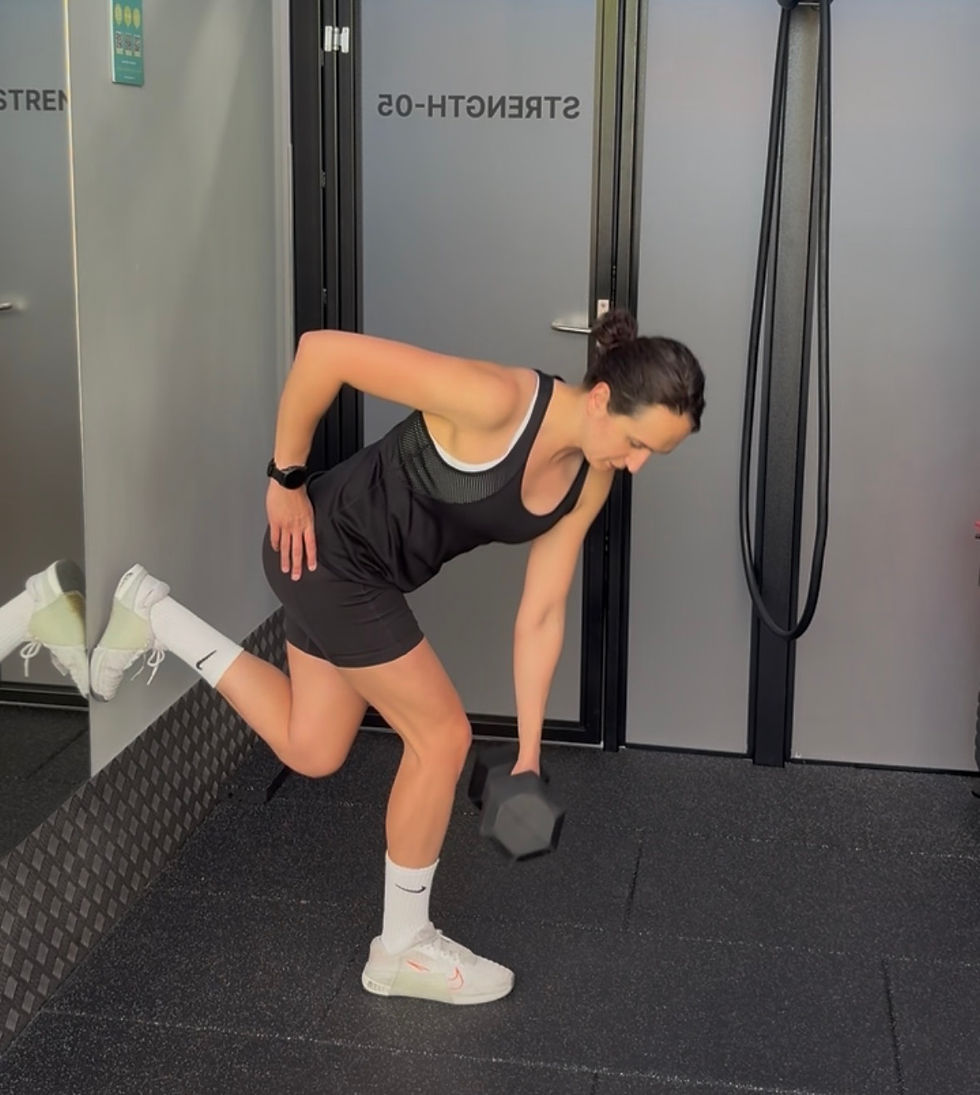
Step-Up
Underrated and highly specific to running. Driving up from a single bent leg closely mirrors the propulsion phase of your stride, making it one of the most functional exercises in a runner's programme.
Lateral Band Walks and Clamshells
These are the targeted glute medius exercises. They sit in the activation and accessory category rather than the heavy strength category, but they fill a gap that the compound lifts don't, specifically loading the outer hip in the lateral plane. Don't underestimate them because they feel easier; that burn in the outer hip is exactly where it needs to be.
 | Why is training the posterior chain important? “The body will often compensate to get the task done, even if it is not using the most efficient strategy. In running, when one muscle group is underperforming, neighbouring tissues can take on extra load, which may contribute to overuse injuries. A good example is Achilles tendinopathy where calf strength is important, but the problem is not always solved by calf loading alone. In many runners, improving glute and hamstring strength can reduce demand through the lower leg and help redistribute load more effectively - Achilles overloading solved!” |
What Well-Designed Strength Training Unlocks
The performance gains from structured strength training tend to show up in a few distinct ways:
Running economy improves: you hold the same pace at a lower heart rate, or you find a faster pace feels more manageable than it used to. This tends to become noticeable around the eight to twelve week mark, once the nervous system adaptations have had time to consolidate.
Stride power increases: particularly in the latter stages of a run or race when fatigue is usually what causes form to deteriorate. Stronger glutes and hamstrings mean more propulsive force is available even when you're tired.
Resilience builds: niggles that have nagged for months like outer hip tightness, knee discomfort, recurring calf issues, often respond well to targeted hip and posterior chain strengthening. Not because strength training is a treatment for injury, but because many running complaints are driven by load being distributed sub-optimally, and correcting that changes the picture.
And perhaps less measurably but equally importantly: confidence grows. Runners who strength train consistently tend to feel robust in a way that changes how they approach hard sessions and race days.
Work With Me
If you're a runner based in East London looking to build a strength programme that's genuinely designed around your running, I offer 1-1 personal training at Gympods in Dalston and hmpt fitness studio in Hackney, as well as fully online coaching for runners who prefer to train independently.

We'll start with a movement assessment to understand how your body is currently moving and where the biggest gains are available, then build a programme that fits around your existing training and actually progresses over time.
Louise Whitting is a Level 3 Personal Trainer, BTF-qualified Triathlon Coach, and Team GB Age-Group Triathlete based in East London. She specialises in strength training for runners and triathletes at fitness studios in Dalston and Hackney.


